SEO is not dead. It’s evolving, as it always has.
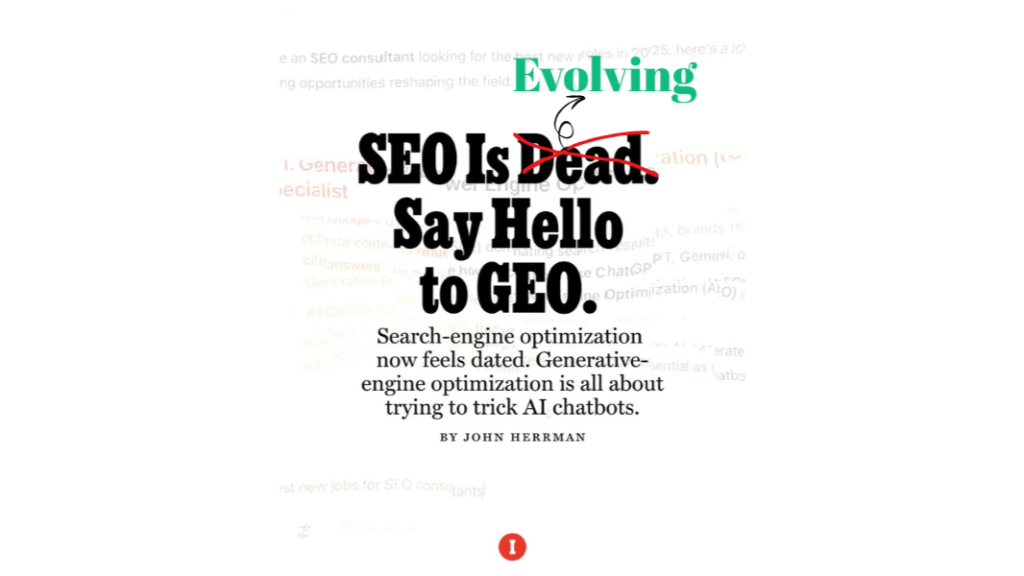
SEO Isn’t Dead — It’s Just Growing Up. Let’s Talk About What’s Really Changing.
Every few years, we see the headline: “SEO is Dead.”
And yet, marketers like me — and businesses that rely on organic traffic — are still here, still optimizing, still growing. The latest version of this declaration comes courtesy of a recent New York Magazine article, “SEO is Dead. Say Hello to GEO,” painting a picture of a world where AI chatbots have made traditional search obsolete.
I get it. It’s a catchy headline. It sparks clicks. But let’s be clear: SEO is not dead. It’s evolving, as it always has.
SEO Has Always Been About Adapting to Where Attention Lives.
Search Engine Optimization was never a static formula. We’ve gone from keyword stuffing to mobile-first indexing, from voice search to schema markups.
The introduction of AI-driven answers (like ChatGPT, Google’s AI Overviews, Perplexity, etc.) is not the end of SEO. It’s the next iteration.
Generative Engine Optimization (GEO) isn’t a replacement for SEO — it’s the next logical progression.
The Core of SEO Hasn’t Changed: Help People Find Valuable Information.
The rules of engagement are shifting:
- AI chatbots are surfacing snippets, summaries, and citations rather than full pages.
- Structured, “snackable” content (think bullet points, comparison charts, clear sources) is now crucial.
- Topical authority across platforms (PR mentions, YouTube, Reddit, Wikipedia) boosts your chances of appearing in AI-generated answers.
But here’s the thing — this is not new. SEO has always been about:
- Serving user intent.
- Building credibility and relevance.
- Optimizing content for the way it’s consumed.
What’s changing is where that consumption happens.
The Real Shift is Platform Control, Not the Death of SEO.
The bigger challenge marketers face is not “SEO dying,” but the consolidation of attention within AI interfaces.
When Google, OpenAI, and Meta decide to keep users in their chat windows, traffic patterns will shift. But the fundamental strategies of:
- Clear, authoritative content
- Technical SEO hygiene
- Strategic brand visibility across platforms are still non-negotiable.
It’s not about gaming algorithms. It’s about being cited as a trusted source.
AI Needs You to Write Like a Human, But Structure Like a Machine.
The best advice for navigating this SEO-to-GEO evolution?
- Write for humans.
- Format for machines.
- Tables, lists, diagrams, and schema-rich content are what AI models can easily summarize and cite.
- Depth and originality still matter. AI doesn’t hallucinate quality.
Who’s Declaring SEO Dead? (Hint: Not Marketers in the Trenches.)
For context, the author of the “SEO is Dead” article, John Herrman, is a talented journalist. But he’s not a marketer. He’s observing from a media critique perspective, not the day-to-day reality of businesses still driving revenue through organic search and content.
SEO practitioners, content strategists, and brand marketers know better: this isn’t the death of SEO — it’s a reset. And resets come with new opportunities for those who adapt.
Final Thought: The Marketers Who Win Are the Ones Who Keep Moving.
The world of SEO has always rewarded those who evolve, not those who panic. GEO is not a funeral for SEO; it’s the next layer.
If Jeff Bezos says, “Bet on things that won’t change,” I’ll tell you this:
- People will always seek information.
- Brands will always need visibility.
- Marketers will always be finding smarter ways to connect the two.
We’re not done. We’re just getting smarter.
Final Thought: The Marketers Who Win Are the Ones Who Keep Moving.
Are you shifting strategies towards GEO tactics? Or do you believe SEO fundamentals will continue to apply, no matter the interface?
#SEO #GEO #ContentMarketing #AI #DigitalMarketing #SearchEngineOptimization #MarketingStrategy #AIOptimization #FutureOfMarketing #AdaptOrDie